Random number wheel
By Arhum Waheed · Updated
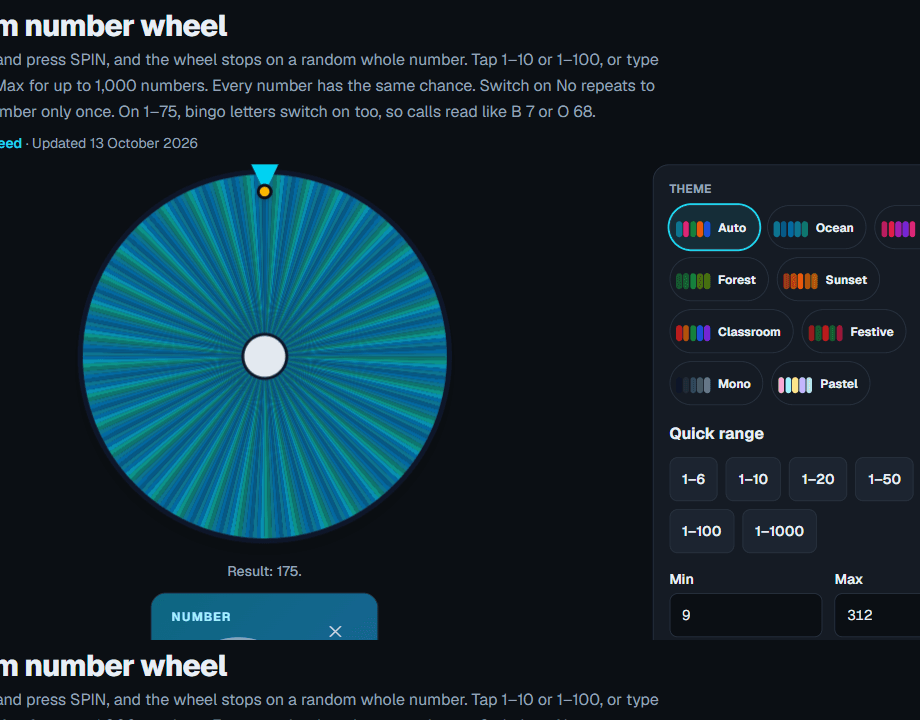
Pick a range and press SPIN, and the wheel stops on a random whole number. Tap 1–10 or 1–100, or type any Min and Max for up to 1,000 numbers. Every number has the same chance. Switch on No repeats to draw each number only once. Tap the 1–75 quick range to switch on No repeats and Show bingo letters together, so calls read like B 7 or O 68.
How to spin a random number
- Tap a quick range, or type a Min and a Max. Use whole numbers, with up to 1,000 numbers in the range. Negative numbers work too.
- Press SPIN. The number under the pointer is your result, shown in large type under the wheel.
- Switch on No repeats if each number should come up only once. Drawn numbers leave the wheel until you press Reset draws.
- Your last 20 numbers are listed under Recent results. Press Copy results to paste them anywhere, or Copy share link to send this range to someone else.
Ways to use a number wheel
- In the classroom. Give each student or desk a number and spin to call on someone, pick which question to answer first, or choose a page to read aloud. For quick math warm-ups, spin twice and have the class add, subtract or multiply the two numbers. To number students off into groups, use the random team generator.
- Board games. Tap 1–6 when a die goes missing. Each spin gives one number from 1 to 6 with the same chance as a fair die.
- Bingo. Tap the 1–75 quick range for a simple US-style bingo caller. That turns on No repeats and Show bingo letters, so each call looks like B 7 or O 68 and is never repeated (you can turn letters off with the toggle). For 90-ball bingo, set Min 1 and Max 90. To make the cards, use the bingo card generator: it prints 75-ball or word cards and has its own caller and card checker.
- Numbered raffle tickets. Set Min and Max to the first and last ticket numbers, switch on No repeats, and spin once per prize. For more than 1,000 tickets, unsold numbers to leave out, several winners in one go, or a written record, use the raffle generator.
- Guessing games and everyday picks. Think of a number and let someone guess, pick a random page of a book, or choose which day of the month to do something.
How the number wheel picks, and what No repeats changes
Each spin picks one number from the numbers still on the wheel, using your browser's secure random number generator, and every one of them has the same chance. The wheel then stops on that number, so the number under the pointer is always the result. Nothing is decided by how hard or how long the wheel spins.
With No repeats off, every spin is independent. The wheel doesn't remember earlier results, so on 1–10 the same number comes up twice in a row about one time in ten. Streaks like that are normal with real randomness.
With No repeats on, each drawn number leaves the wheel, so the remaining numbers become more likely as the pool shrinks. On 1–10, each number has a 1 in 10 chance on the first spin, 1 in 9 on the second, and the last number left is certain. That's how a bingo caller or a ticket draw works.
Up to 60 numbers, every slice has its own label. On bigger ranges the slices get very thin, so the wheel labels every few slices and shows the result in large type. Every number is still in the draw.
Odds on a number wheel
| Range | Chance per spin | With No repeats: 2nd draw | 10th draw |
|---|---|---|---|
| 1–6 | 1 in 6 (about 16.7%) | 1 in 5 | n/a |
| 1–10 | 1 in 10 (10%) | 1 in 9 | 1 in 1 (last number) |
| 1–75 (bingo) | 1 in 75 (about 1.3%) | 1 in 74 | 1 in 66 |
| 1–100 | 1 in 100 (1%) | 1 in 99 | 1 in 91 |
| 1–1000 | 1 in 1,000 (0.1%) | 1 in 999 | 1 in 991 |
With No repeats off, every spin is independent, so the odds stay the same as the first column on every spin.
Number wheel ideas
A number wheel is the most flexible picker on ExesTools, because almost anything can be numbered. Here are six setups that go beyond "pick a number," with the exact settings to use.
1. Raffle ticket numbers at a small event
You sold tickets 101 to 180 at a school stall. Set Min to 101 and Max to 180, switch on No repeats, and spin once per prize. Read each number out and wait for the holder to come forward before the next spin. If nobody claims a number, spin again: because No repeats is on, the unclaimed ticket is already out of the draw.
When the draw is over, press Copy results. It copies your last 20 numbers, so you can paste them straight into a message to the organizing committee.
If some tickets in the book were never sold, this page can't leave them out. Use the raffle generator, which has a Leave out list for unsold tickets, or reduce the range so it only covers the books you sold.
2. Homework or practice problem picker
A worksheet has 40 problems and you want students to do 6 of them, different for each class. Set Min 1 and Max 40, switch on No repeats, and spin six times. Write the numbers on the board as they come up.
Want only odd-numbered problems, because the answers are in the back of the book? Spin 1 to 20 instead and convert each result with 2n − 1: a spin of 7 means problem 13, a spin of 20 means problem 39. Every odd problem from 1 to 39 is equally likely, because each one matches exactly one number on the wheel. For even problems, use 2n.
3. A dice replacement, with honest odds
Tap 1–6 when a die goes missing. One spin gives the same odds as one fair die: each number has a 1 in 6 chance, about 16.7%.
Two dice are different, and this trips people up. A game that rolls two dice and adds them doesn't give every total the same chance. Spinning 1–12 once is not a replacement for two dice. Spin 1–6 twice and add the results instead. Here is why it matters:
| Total | Ways with two dice | Chance with two 1–6 spins | Chance with one 1–12 spin |
|---|---|---|---|
| 2 | 1 | 2.8% | 8.3% |
| 3 | 2 | 5.6% | 8.3% |
| 4 | 3 | 8.3% | 8.3% |
| 5 | 4 | 11.1% | 8.3% |
| 6 | 5 | 13.9% | 8.3% |
| 7 | 6 | 16.7% | 8.3% |
| 8 | 5 | 13.9% | 8.3% |
| 9 | 4 | 11.1% | 8.3% |
| 10 | 3 | 8.3% | 8.3% |
| 11 | 2 | 5.6% | 8.3% |
| 12 | 1 | 2.8% | 8.3% |
| 1 | 0 | 0% | 8.3% |
Board games are balanced around 7 being the most common total. Swap in a single 1–12 spin and a 2 or a 12 becomes three times as likely, and 1 becomes possible. Keep No repeats off for dice, since a die can roll the same number twice.
For a twenty-sided die in a tabletop role-playing game, tap 1–20.
4. Lottery-style picks for games and classroom math
For a "pick six numbers" game at a party or a probability lesson, set Min 1 and Max 49, switch on No repeats, and spin six times. Press Copy results to keep the set.
This is a good way to show a class how unlikely a jackpot is. The number of different six-number sets from 1 to 49 is 13,983,816, so any one set has a 1 in about 14 million chance. A wheel, a computer and a lucky birthday all pick sets with exactly the same odds. No method of choosing numbers improves them. The number wheel is for games and lessons; it doesn't predict anything.
5. Random page numbers
For a reading game, a "random page" writing prompt or picking where to start revising, set the range to the pages that actually have content. A novel with 312 pages whose first chapter starts on page 9 should be set to Min 9 and Max 312, so the front matter never comes up. Leave No repeats on if you're running a whole lesson of random-page prompts and don't want to repeat one.
6. A rounding warm-up
Set Min 100 and Max 999, leave No repeats off, and spin five times. Say you get 312, 845, 650, 199 and 503.
| Spin | Nearest 10 | Nearest 100 |
|---|---|---|
| 312 | 310 | 300 |
| 845 | 850 | 800 |
| 650 | 650 | 700 |
| 199 | 200 | 200 |
| 503 | 500 | 500 |
Students write their answers on whiteboards before you reveal each row. The 650 row is the one that sparks discussion: it's already a multiple of 10, and it sits exactly halfway between 600 and 700, so the usual round-half-up rule sends it to 700. Using a fresh spin each time means nobody can memorize the answers from yesterday's worksheet.
A higher-or-lower game that teaches strategy
Spin a number from 1 to 100 without showing it, or have one player look away while another spins. Everyone else guesses, and the holder only answers "higher" or "lower."
It's a quick game, but it hides a neat piece of math. If you always guess the middle of the numbers that are still possible (50, then 25 or 75, and so on), you halve the options with every guess. Since 2 multiplied by itself 7 times is 128, which is more than 100, the halving strategy always finds the number in 7 guesses or fewer. For 1 to 1,000, it takes at most 10, because 2¹⁰ is 1,024.
Try it with a class: let students play a few rounds freely, count their guesses, then teach the halving strategy and play again. The drop in guesses is the lesson. It's an easy introduction to binary search for older students, and to number sense and place value for younger ones. Keep No repeats off between rounds, so a number can come up again just as it would in a fresh game.
A worked example: three winners from 250 tickets
Say you sold 250 numbered tickets and you're drawing three prizes with No repeats on.
- First spin: every ticket has a 1 in 250 chance (0.4%).
- Second spin: one ticket is gone, so each remaining ticket has a 1 in 249 chance.
- Third spin: 1 in 248.
Over the whole draw, each ticket's chance of winning one of the three prizes is exactly 3 in 250, or 1.2%. That is the same for every ticket, whether it was sold first or last, and whether it's a "lucky-looking" number like 77 or a dull one like 143.
Someone who bought 5 of the 250 tickets has a chance of winning at least one prize of 1 − (245/250 × 244/249 × 243/248), which is about 5.9%. That's slightly under 5 × 1.2% = 6%, because the five tickets can't all win.
Choosing a range that matches the job
A few small details save confusion:
- Both ends are included. Min 1 and Max 10 puts ten numbers on the wheel, 1 and 10 included. The count is always Max − Min + 1.
- Up to 1,000 numbers fit in one range. 1 to 1,000 works; so does 5,001 to 6,000. For bigger ticket ranges, use the raffle generator.
- Negative numbers work. −10 to 10 holds 21 numbers, including 0. That's useful for temperature or number-line games in a math lesson.
- Whole numbers only. For a random decimal, spin a whole number and divide: 1 to 100 divided by 10 gives 0.1 to 10.0 in steps of 0.1.
Numbers instead of names, for privacy
A number wheel is a simple way to pick people without typing anyone's name into a website. Give each person a number on paper, in a register or on a seating plan, and spin the range. Nothing on the page identifies anyone, and if you press Copy share link, the link only carries your range and settings, not a list of people.
This works well for:
- Classes with a numbered register, where every student already has a number.
- Workshops and events, using badge or seat numbers.
- Online meetings, where you can number participants in the order they appear and read out the result.
The trade-off is that the wheel shows "14" rather than "Priya," so someone has to look up who 14 is. If you'd rather see names and your school or workplace is comfortable with that, the classroom spinner and the name picker do the same job with names on the slices.
When to turn No repeats on
Ask one question: should the same number be able to come up twice?
- Yes, it should for dice, guessing games and anything where each spin stands alone. Leave No repeats off.
- No, it shouldn't for tickets, seats, questions, problems and bingo calls. Switch it on. The wheel works through the range and tells you when it's empty, with Reset draws to start again.
If you change your mind halfway through a draw, finish the round first. Switching modes partway makes it hard to explain to anyone watching which numbers were still in play.
A few habits help either way:
- Copy results at the end of a draw if you need a record of what came up.
- Copy share link sends the range and settings, not any names.
Frequently asked questions
How do I pick a random number between 1 and 100?
Tap the 1–100 quick range and press SPIN. Every number has a 1 in 100 chance on each spin.
Can I draw several numbers without repeats?
Yes. Switch on No repeats. Each drawn number leaves the wheel until you press Reset draws, and your last 20 results are listed under Recent results.
What's the biggest range?
Up to 1,000 numbers in one range, such as 1–1000. Negative numbers work too.
Can I use it as a bingo number caller?
Yes, for a simple game. Tap the 1–75 quick range: that switches on No repeats and Show bingo letters, so calls look like B 7 or O 68. You can turn letters off with the toggle. Recent results lists your last 20 calls. For the players' cards, use the bingo card generator.
Can I use it for a raffle?
Yes, for up to 1,000 numbered tickets: set Min and Max to your ticket range and switch on No repeats. For bigger ranges, names with several tickets each, or several winners and alternates in one draw, use the raffle generator. To spin for names on a wheel, use the prize wheel.
Can the same number come up twice in a row?
Yes, when No repeats is off. Each spin is independent, so on 1–10 the same number can land twice in a row about one time in ten. Switch on No repeats if each number should only appear once until you reset.
Do negative numbers work on the wheel?
Yes. Set a negative Min or Max—for example −10 to 10. The wheel picks one whole number at random from every number still in that range.
What happens when every number has been drawn?
With No repeats on, each result leaves the wheel until the range is empty. The tool then tells you and offers Reset draws so you can run the range again.
Can I use the number wheel as a dice roller for tabletop games?
Yes. Set the range to match the die, such as 1–20 for a d20 or 1–8 for a d8, and leave No repeats off so numbers can repeat like real dice.
How do I pick a random day of the month?
Set Min 1 and Max 28 for a day that exists in every month, or 1–31 if you're happy to respin when a date doesn't exist.
Can I share my range with a class or a friend?
Yes. Copy share link sends your range and settings. The other person opens the same wheel on their device.
Is every number equally likely?
Yes. Each spin picks one whole number from the numbers still on the wheel with your browser's secure random number generator, and every one of them has the same chance. With No repeats on, the remaining numbers become more likely as drawn numbers leave, but they stay equal to each other. Learn more: How ExesTools picks a result.
Can I skip certain numbers?
Not directly. This page doesn't have an option to exclude individual numbers from a range. You can narrow the range, convert results (spin 1–20 and use 2n − 1 for odd numbers only), put the exact numbers you want on the spinner wheel one per line (up to 60), or use the raffle generator's Leave out list for ticket numbers.
Choosing between names or options instead of numbers? Use the spinner wheel.